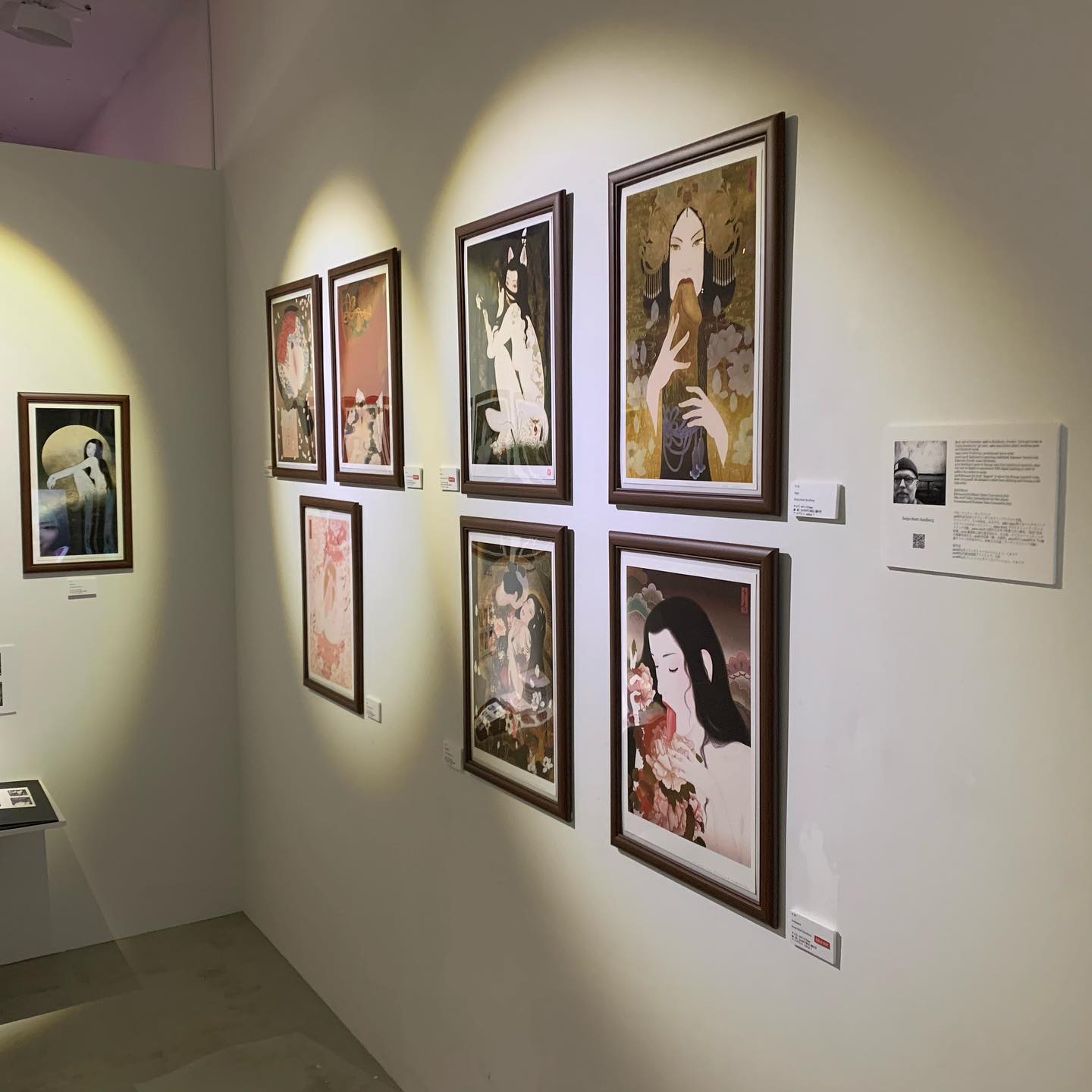

My interest in Japanese art the past years has been partially influenced by my talks with contemporary Swedish shunga artist Matti “Senju” Sandberg, whose work engages with the rich visual traditions of Japanese erotic art. In addition to this, he is also a highly regarded tattoo artist specialising in traditional Japanese tattooing (irezumi). I have the privilege of receiving extensive tattoo work from him, and the motifs he is currently creating on me have provided a personal connection to many aspects of Japanese visual culture, with a personal preference for big-balled Tanuki. Through his art, you can appreciate how historical themes continue to inspire contemporary artists working both within and beyond Japan. That being said, to understand contemporary shunga, we need to look towards its humble beginnings.
The history of shunga occupies a distinctive place within the broader development of Japanese art. The term shunga, meaning “spring pictures”, refers to erotic paintings, illustrations, and woodblock prints that flourished particularly during the Edo period (1603–1868). Although often viewed solely through the lens of sexuality, shunga constituted a significant artistic genre that reflected social customs, humour, literary culture, and changing attitudes towards intimacy and human relationships.
The origins of Japanese erotic art can be traced to influences from China, where erotic illustrated scrolls had long formed part of elite artistic culture. By the medieval period, similar works were being produced in Japan, often as hand-painted scrolls intended for aristocratic patrons. These early examples combined explicit imagery with sophisticated narrative elements and frequently drew upon themes from classical literature.
Shunga reached its greatest popularity during the Edo period, an era characterised by urban growth, commercial prosperity, and the flourishing of popular culture. Advances in woodblock printing enabled artists to produce large quantities of affordable illustrated books and prints for an expanding urban audience. Unlike many forms of elite art, shunga was accessible to merchants, artisans, and townspeople, becoming a widespread feature of everyday cultural life.
Many of the most celebrated artists of the ukiyo-e tradition produced shunga at some point during their careers. Among them were Hishikawa Moronobu, Kitagawa Utamaro, Katsushika Hokusai, and Utagawa Kuniyoshi. These artists approached erotic subject matter with the same technical mastery found in their landscapes, portraits, and historical scenes. Their works often display remarkable attention to costume, architecture, gesture, and emotional expression.
Contrary to modern assumptions, shunga was not regarded solely as pornography. It served multiple social and cultural functions. Newly married couples were sometimes given shunga as educational material, while travellers carried small illustrated books for entertainment. The prints frequently contained humour, satire, and literary references that would have been readily understood by contemporary audiences. In many cases, the erotic scenes were embedded within broader narratives concerning romance, domestic life, or the pleasures of the floating world (ukiyo).
Despite its popularity, shunga periodically attracted official disapproval. The Tokugawa authorities occasionally introduced regulations restricting the production of explicit imagery, although enforcement was inconsistent and often ineffective. As a result, artists and publishers continued to produce shunga throughout much of the Edo period.
The situation changed dramatically during the Meiji period (1868–1912). As Japan sought to modernise and present itself as a nation comparable to the Western powers, attitudes towards erotic art became increasingly influenced by Victorian moral values. New censorship laws restricted the production and circulation of explicit material, leading to the decline of traditional shunga publishing.
In the twentieth century, however, scholars and art historians began to reassess shunga as an important component of Japanese cultural heritage. Museums and academic institutions increasingly recognised its artistic, historical, and social significance. Research has demonstrated that shunga provides valuable insights into gender relations, urban culture, publishing practices, and popular entertainment in pre-modern Japan.
Today, shunga is widely studied as an integral part of Japanese art history rather than merely a form of erotic imagery. Major exhibitions in Japan, Europe, and North America have introduced new audiences to its artistic sophistication and cultural complexity. Contemporary artists, tattooists, and illustrators continue to draw inspiration from its visual language, demonstrating the enduring influence of a tradition that has evolved over several centuries.
The history of shunga therefore reveals far more than changing attitudes towards sexuality. It illustrates the vitality of Japanese popular culture, the creativity of its artists, and the capacity of visual art to explore both the intimate and the universal aspects of human experience.
References for further reading (art nerds unite!)
Hayakawa, Monta. The Shunga of Suzuki Harunobu: Mitate-e and Sexuality in Edo. Kyoto: International Research Center for Japanese Studies, 2001.
Hayakawa, Monta. Shunga: Himetaru Warai no Sekai (The Hidden World of Humour in Shunga). Tokyo: Yōsensha, 2003.
Hayakawa, Monta. Shunga no Mikata: Jū no Pointo (Ten Viewpoints on Shunga). Tokyo: Heibonsha, 2008.
Gerstle, C. Andrew and Timothy Clark. Shunga: Sex and Humour in Japanese Art and Literature. Kyoto: International Research Center for Japanese Studies, 2013.